Securitized ESG Products
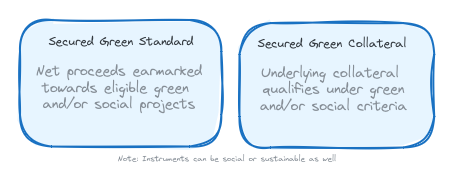
The common path to categorize an instrument to be Green, Social or Sustainable is through the ‘use of proceeds’ or ‘labeled’ approach. As a reminder, labeled ESG products are instruments whereby the issuer commits an amount equal to the net proceeds raised from an issuance (i.e., amount raised minus transaction fees and expenses) to be earmarked for eligible green and/or social projects. Within the secured or securitization market, interestingly, there have been two avenues to classify an instrument to be ESG labeled and this article breaks those two approaches down.
Let’s step back a bit and level set on the fundamentals. Securitized debt instruments are created by pooling together various types of assets - common ones include mortgages, auto loans, or credit card receivables - and packaging them into tradable securities. The bundle of assets are often called collateral and, at times, that collateral fulfills social or green eligibility criteria typically seen within the sustainable finance market. These instruments are called ‘Secured Green Collateral Bonds.’ Note: For illustrative purposes, I will be using green throughout this article but issuances can be structured as green, social or sustainable.
For ‘Secured Green Collateral Bonds’, there isn’t a requirement to earmark funds towards specific ESG projects since the underlying collateral for the instrument qualifies under the eligibility criteria. Even though, issuers don’t have to allocate proceeds towards green or social projects, there is a requirement by the sustainable finance market to obtain a “pre-issuance review” of the collateral and whether or not it meets the eligibility criteria.
How to Issue a Secured Green Collateral Bond
First, issuers looking to structure a securitization as ESG labeled would need to create a Framework and obtain a Second Party Opinion. Within the Framework, companies would detail and describe what their eligibility criteria is. For a reminder of the core components of a Framework, refer to the previous #esgeazy article. As the company finalizes its collateral package for an issuance, they can see if those assets qualify under their established Framework. If yes, they have the optionality of structuring a Secured Green Collateral Bond. Before marketing, the sustainable finance market typically expects that the issuer obtains a “pre-issuance review.” Pre-issuance reviews can be performed by any reputable external party including financial auditor or consulting firm and most of the time it is completed by Second Party Opinion (SPO) Providers such as Sustainalytics. The SPO providers’ role is to confirm that the collateral is aligned with the Sustainable Finance Framework that the company has. Pre-issuance reviews doesn’t mention or opine on the credit worthiness of the collateral or a transaction structure, just whether or not the collateral falls under the criteria set forth within the Framework.
Let’s walk through an example. Trinity Industries Inc. (referred to as “Trinity”,“Company”) is company within the industrials sector that provides rail products and railcar leasing & management.
Within Trinity Industry’s Second Quarter 2022 press release, we see the following transaction in 2022:
Trinity Q2 2022 Press Release Link
From this excerpt, we can see that a subsidiary of Trinity Industries Inc. issued green notes which they named “TRL-2022 Notes.” The Company for this transaction utilized S&P Global to rate their collateral and here is their pre-sale report. Within the report, we can see that the collateral TRL-2022 Notes is 3,652 railcars and associated lease payments.
S&P Pre-Sale Report
Now for the green piece, Trinity established and published a Green Financing Framework in 2021. Within the document, Trinity defines a single project category called “Low-Carbon Transportation” whereby investment related to acquiring, leasing, improving and refurbishing fright railcars would qualify as Green spend. (Note: In 2021, Trinity received a SPO on its Green Financing Framework’s alignment to ICMA’s Green Bond Principles).
Trinity Green Financing Framework (2021)
For this TRL-2022 securitization, Trinity used Sustainalytics for their pre-issuance review to opine on the transaction’s alignment to the 2021 Trinity Green Financing Framework. The document outlines the the collateral for the TRL-2022 transaction aligns with the green eligibility criteria stated within Trinity’s Green Financing Framework.
Sustainalytics TRL-2022 Pre Issuance Review
And there you have it! Trinity for its TRL-2022 has all the necessary components and can market its security as a Secured Green Collateral Bond! (Didn't really mention the minutia of embedding the language within the transaction's legal document, etc. but the core ESG financing components are described!)
The Good Ole Reliable Option: Secured Green Standard Bonds
As you can imagine, not all issuers within the securitization market can guarantee that the underlying collateral fulfills the eligibility criteria. Many when looking to issue within the securitized market can’t really optimize for green / social eligibility and have to choose collateral based on other factors such as the asset credit ratings. In those instances, there is still the option to access the sustainable finance market through the ‘use of proceeds’ approach and called “Secured Green Standard Bond.” This is basically how “traditional” labeled ESG bonds work. The issuer raises a bond and then commits to allocating an amount equivalent to the net proceeds towards eligible green and/or social projects. One year post issuance and annually until full allocation, the company is required to report on where the expenditures have been allocated and, where feasible, any associated impact metrics.
The Combined Approach and Recap of ESG Securitizations
Though the market and investors have shifted towards the “Secured Green Standard” and “Secured Green Collateral” approaches, there have been a few precedents that have opted for a more stringent dual pronged approach. Here, net proceeds are allocated to eligible green / social categories and the underlying collateral qualifies under the eligibility criteria. So far, only companies that have been considered a pure-play ESG business (e.g., solar loan provider) have been able to categorize their instruments as Secured Green Standard & Collateral and it is unclear if there is incremental execution benefit for taking the dual pronged option.
Within this subsection of the sustainable finance market and when structuring a Framework to issue a ESG securitization, it is important for issuers to consider which approach to take, Secured Green Standard Bond or Secured Green Collateral Bond, and to ensure that language within the Framework includes flexibility for either or both the ESG securitization approaches as well as for multiple transactions.
Below is an illustration with an overview of the ESG securitization and approaches.